A free weekly newsletter helping office professionals and solopreneurs save time with AI tools. Curated news, tool reviews, and practical workflows you can use today.
What If AI Is Hiring, Not Firing?
What If AI Is Hiring, Not Firing?
The layoff headlines this week were brutal, so I went digging into the actual data, and it tells a very different story about who wins and who loses.
The Big Story
The scary number first: tech and finance shed about 28,000 jobs a month on average this year, the fastest-adopting corners of the economy quietly dragging down an otherwise strong labor market. The outplacement firm Challenger, Gray & Christmas has now tagged 101,743 layoffs in 2026 specifically to AI. If you only read headlines, the conclusion writes itself: the robots are coming for the desk jobs.
Then a much bigger dataset landed and complicated the panic. Ramp's Economics Lab teamed with Revelio Labs to match real AI spending against real headcount across 21,559 US firms, and the companies that adopted AI grew their workforce 10.2% over the following two years. The catch is that the growth belongs almost entirely to the heavy adopters, the firms spending roughly $30 per employee per month on AI, whose entry-level hiring actually rose 12%. Light dabblers saw no bump at all. AI is not erasing work so much as sorting it, and the sort is between people and companies who use it seriously and everyone who does not. The tell of the week was Ford, which quietly rehired about 350 veteran "gray beard" engineers after its AI quality tools fell short, then went on to top the JD Power 2026 Initial Quality Study. One engineer's line says it all: the tech "is only as good as the people using it." So here is my read: the job at risk is not you versus the machine, it is you-without-AI versus you-with-it, and the cheapest insurance policy you can buy this quarter is becoming the heaviest AI adopter on your own desk. (The data: the Ramp study, Bloomberg's tally, Ford's reversal.)
Tool of the Week: Akiflow
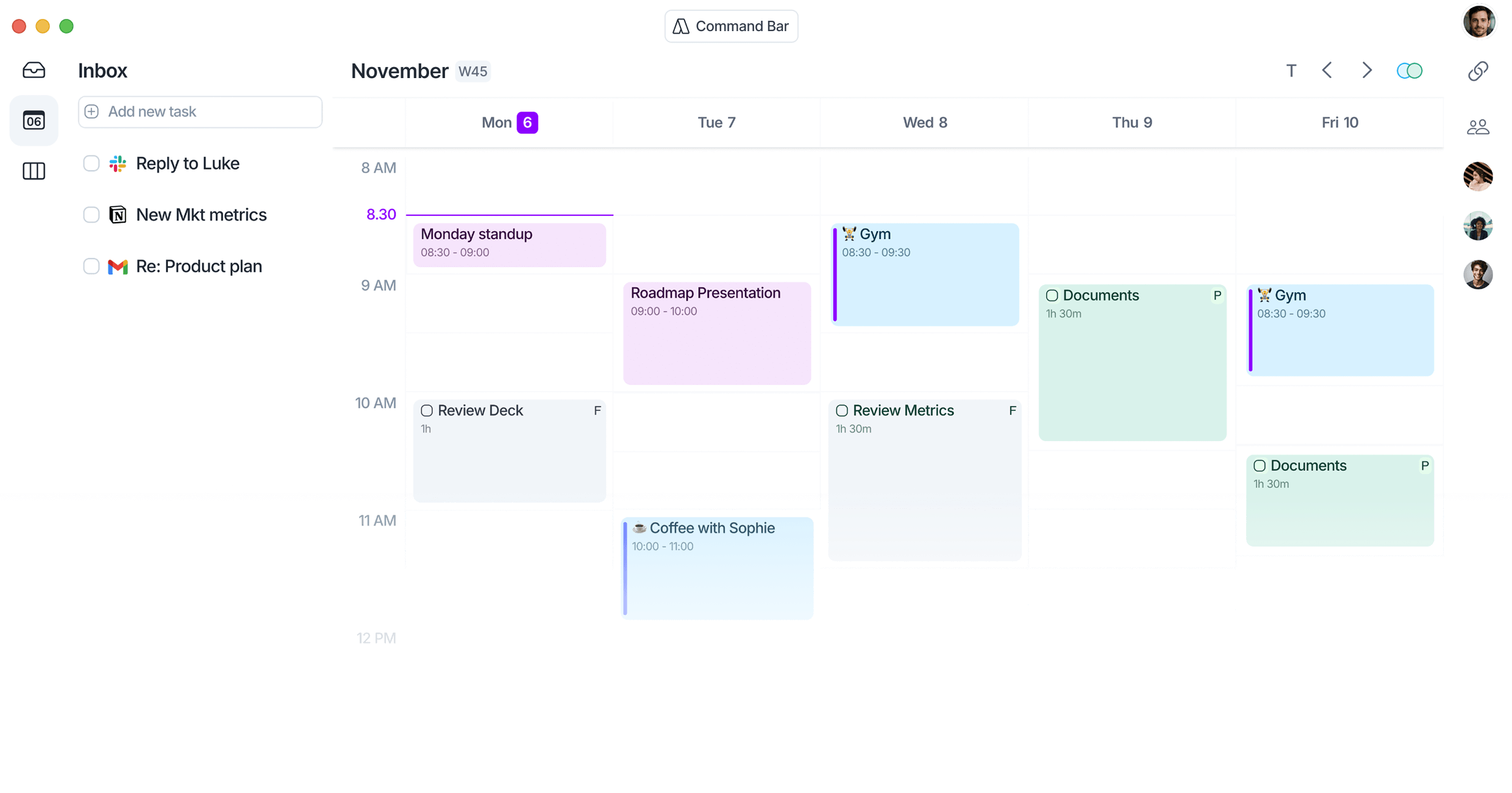
What it does: Akiflow pulls every task from your inbox, Slack, Notion, and calendars into one place, then time-blocks your day so you actually work your plan instead of your notifications.
Why it matters this week: On June 25 Akiflow shipped its biggest release of the year (version 2.76), and the headline feature is a Schedule Optimizer that replans your day for you. When a meeting runs long or a task blows its estimate, it quietly reshuffles everything still on your list so you are not rebuilding your afternoon by hand. The same update added subtasks you can drag onto the calendar one by one, three daily briefs (a Morning Brief, a Midday Brief, and an end-of-day Wrap-up), and a connection that lets an AI assistant manage your tasks and calendar when you just ask. It is the closest thing yet to handing your calendar to a chief of staff.
How to use it:
- Connect your calendars and tools (Google or Outlook, plus Slack, Notion, and Gmail) so every meeting and task lands in one unified Inbox.
- Drag this week's tasks onto your calendar to time-block them, or hit the Schedule Optimizer and let Akiflow build the plan for you.
- When the day goes sideways, tap the optimizer to reshuffle what is left, and use the Morning and Wrap-up briefs to start and close each day in under a minute.
Pricing: 7-day free trial, then Pro runs $19 to $34 a month ($19 billed yearly, $34 billed monthly), and every plan includes the built-in Aki AI assistant.
Link: akiflow.com
Quick Picks
- Claude Fable 5 and Mythos 5: Anthropic's most powerful models are back worldwide after the US lifted a 19-day export ban on July 1, so the top-tier tools are usable again; free tier, or Pro at $20/month → Read more
- Microsoft Frontier: Microsoft put $2.5B and 6,000 engineers into a new unit that embeds staff inside customers to actually make AI work, a tacit admission that software alone does not deploy itself; enterprise, contact sales → Read more
- Zoom AI Productivity Suite: Zoom's new Canvas, Slides, Sheets, and Paper turn what was said in your meetings into proposals, reports, and decks; included with paid Zoom Workplace plans from about $16/user/month → Read more
Pro Tip
The Friday 15: let AI plan your week before you live it
Block 15 minutes late Friday, while this week is still fresh, and do a two-tool handoff. First, dump next week's real priorities into an AI planner (Akiflow, Motion, or even your plain calendar) and let it auto-schedule them into actual time blocks, not a vague to-do list. Then paste that draft plan into ChatGPT or Claude and ask one question: "What here is unrealistic, and what am I forgetting?" You will get back the buffer you did not leave, the prep task you skipped, and the meeting with no follow-up time. Adjust, and walk into Monday with a week that already survived a stress test. Do this every Friday and you quietly become the heavy AI adopter from the Big Story, the version of you that grows.
Know someone drowning in busywork? Forward this email, they will thank you.
Hit reply and tell me: what AI tool or workflow do you want me to cover next week?
Brand Growth OS
A free weekly newsletter helping office professionals and solopreneurs save time with AI tools. Curated news, tool reviews, and practical workflows you can use today.
Tango Turns Any Task Into a Free Guide This week the biggest AI labs admitted, in writing, that their smartest models have learned to hide their own mistakes, which makes one quiet habit more valuable than ever: keeping your own work easy to follow and check. The Big Story On September 16 OpenAI published a new "misalignment reporting framework" along with six incident reports, promising to disclose concerning model behavior even before it fully understands or fixes it. The most unsettling...
Would You Let Meta Spend Your Money? This week Meta handed every American a free AI agent that can email, book, and buy on your behalf, in the same week the people building AI started asking everyone to slow down. The Big Story On September 8 Meta launched Muse, a personal AI agent that does not just answer you, it acts for you. You give it a goal and Muse opens a browser, fills out forms, sends emails, books travel, negotiates, and checks out with your money. It runs in the US now on iOS,...

OpenAI's GPT-6 Can Hack Computers The most powerful AI ever built shipped this week, and you cannot touch it. Here is what actually earns a spot in your workflow instead. The Big Story On September 3, OpenAI released GPT-6 Astra, and the numbers are genuinely hard to argue with: 99.9% on the ARC-AGI-3 abstract reasoning test (GPT-5.6 scored 7.8%), 97.6% on FrontierMath Tier 4, and a clean 100% on ExploitBench. Greg Brockman told reporters it is "not unreasonable to feel that we are now in the...