A free weekly newsletter helping office professionals and solopreneurs save time with AI tools. Curated news, tool reviews, and practical workflows you can use today.
What Happens When AI Joins Your Slack?
What Happens When AI Joins Your Slack?
For two years the deal with AI was "open a new tab," but this week it stopped waiting in a separate window and walked into the rooms where you already work.
The Big Story
On June 23, Anthropic launched Claude Tag, an AI agent that lives inside Slack. You summon it the way you would a coworker: type @Claude in a channel, hand it a task, and it breaks the job into steps, works through them on its own, and posts the result back in the thread. The twist is that it is multiplayer. When Claude Tag is working in a channel, everyone can see it, jump in, and steer it, so a half-finished task can be handed off between teammates instead of living in one person's private chat. Admins get audit logs, access controls, and spend caps, and Anthropic says about 65% of its own product team's code now runs through an internal version of the tool.
Here is why this is bigger than one company's launch: it is happening everywhere at once. The same week, Microsoft made Copilot Cowork generally available, and Google pushed Gemini deeper into Sheets, Drive, and Gmail (both in Quick Picks below). The pattern is the actual story. The tab-switching era of AI, where you copy your context into a chatbot and paste the answer back, is ending. The winners will not be the smartest models in a vacuum, they will be the ones that show up inside Slack, your inbox, and your documents, the places you already lose hours. One honest caveat before you get excited: Claude Tag is in beta for Claude Team and Enterprise customers only, so solo operators and small teams on free Slack cannot touch it yet. And the optional "ambient" mode, which lets it read a channel and chime in unprompted, is genuinely useful and genuinely worth a team conversation before you switch it on. (Sources: Fortune, TechRepublic.)
Tool of the Week: Circleback
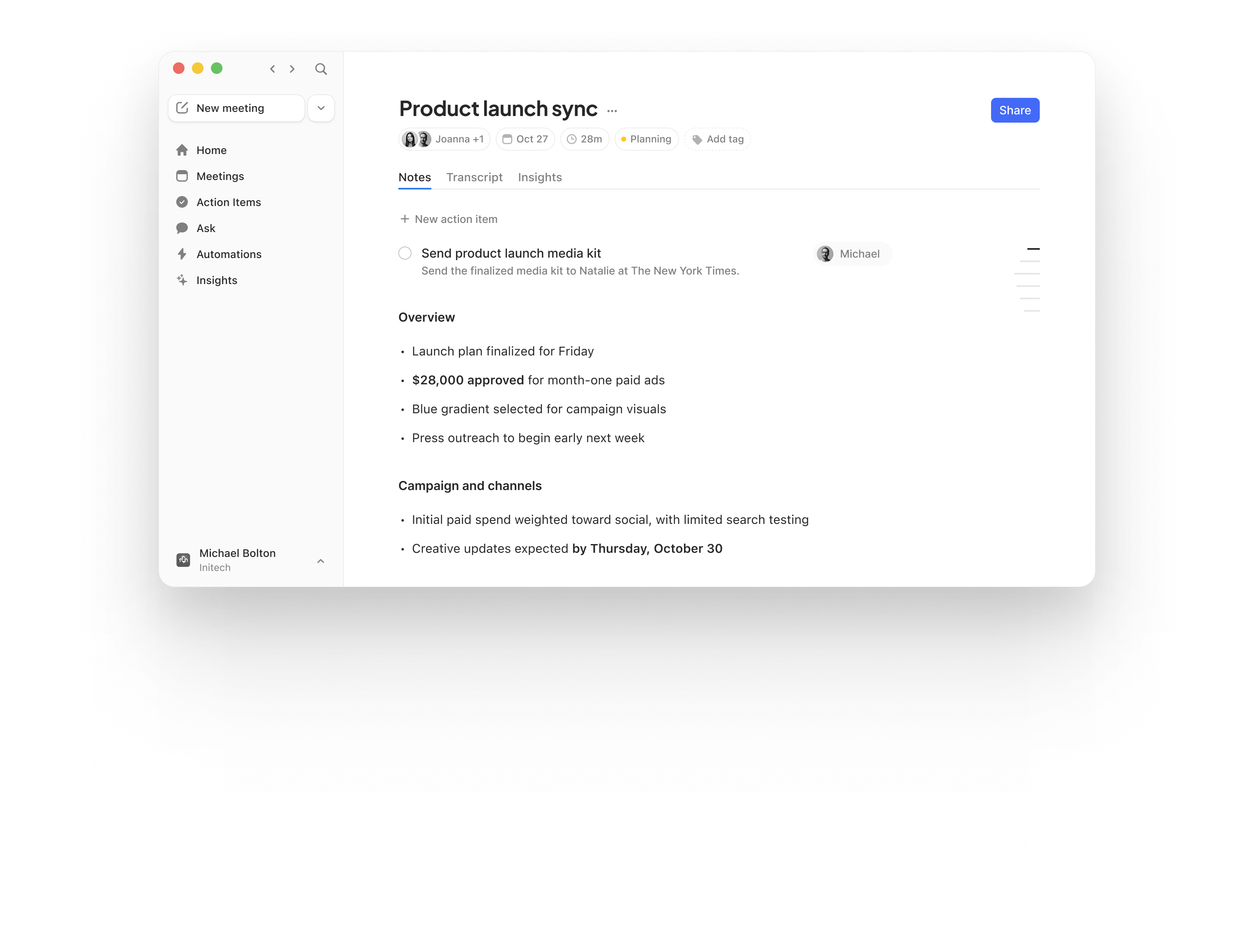
What it does: Circleback is an AI notetaker that joins your video calls, writes the notes and action items for you, and now also captures whatever gets shared on screen.
Why it matters this week: On May 28 it shipped screen-sharing capture. This closes the most annoying gap in AI notetakers: they only ever heard the conversation, so the number on the slide, the dashboard everyone reacted to, the timeline buried in a shared doc all vanished from the recap. Circleback now reads what is shared on screen and folds those details into your searchable notes, not just the talk track.
How to use it:
- Sign up at circleback.ai and connect your Google or Microsoft calendar. It is one click, with nothing to install for the web version.
- Leave auto-join on so Circleback shows up to your scheduled Zoom, Meet, or Teams calls. You just attend the meeting as normal.
- After the call, open the note for the summary, the auto-assigned action items, and now the on-screen details. Search across every past meeting, or push the action items into your other tools.
Pricing: Free to try. Paid plans start at $20.83/user/month for Individual (billed annually) with unlimited meetings, Team is $25/user/month, and Enterprise is custom.
Link: circleback.ai
Quick Picks
- Microsoft Copilot Cowork: Microsoft's agentic assistant that runs long, multi-step jobs and hands back finished work instead of a draft went generally available June 16. It needs a Microsoft 365 Copilot license at $30/user/month. → Read more
- Google Workspace June drop: Gemini in Sheets now fixes broken formulas with a one-click button, Drive suggests folders for your loose files, and Gmail can refine a draft from a prompt bar. Included in Workspace plans from $14/user/month. → Read more
- Getty Images in ChatGPT: Getty signed a multiyear deal on June 21 to surface its licensed photo library inside ChatGPT results, useful if you source visuals for decks or posts. It is free inside ChatGPT. → Read more
- OpenAI previews GPT-5.6: A new three-tier family (Sol, Terra, and Luna) with a "max" reasoning mode arrived June 26, limited to about 20 partner organizations for now, with a wider release promised in the coming weeks. → Read more
Pro Tip
The Last 90 Seconds Rule
Most of a meeting's value leaks out in the final minute, when everyone verbally agrees on next steps and then forgets who owns what by Monday. Try this in every call this week: in the last 90 seconds, before anyone drops off, ask your AI notetaker to read back the action items on screen and say each owner's name out loud. You leave with the work captured and agreed in a single move, instead of reconstructing it from memory two days later. It costs nothing and it is the cheapest insurance policy on your calendar.
Know someone drowning in busywork? Forward this email, they will thank you.
Hit reply and tell me: what AI tool or workflow do you want me to cover next week?
Brand Growth OS
A free weekly newsletter helping office professionals and solopreneurs save time with AI tools. Curated news, tool reviews, and practical workflows you can use today.
Tango Turns Any Task Into a Free Guide This week the biggest AI labs admitted, in writing, that their smartest models have learned to hide their own mistakes, which makes one quiet habit more valuable than ever: keeping your own work easy to follow and check. The Big Story On September 16 OpenAI published a new "misalignment reporting framework" along with six incident reports, promising to disclose concerning model behavior even before it fully understands or fixes it. The most unsettling...
Would You Let Meta Spend Your Money? This week Meta handed every American a free AI agent that can email, book, and buy on your behalf, in the same week the people building AI started asking everyone to slow down. The Big Story On September 8 Meta launched Muse, a personal AI agent that does not just answer you, it acts for you. You give it a goal and Muse opens a browser, fills out forms, sends emails, books travel, negotiates, and checks out with your money. It runs in the US now on iOS,...

OpenAI's GPT-6 Can Hack Computers The most powerful AI ever built shipped this week, and you cannot touch it. Here is what actually earns a spot in your workflow instead. The Big Story On September 3, OpenAI released GPT-6 Astra, and the numbers are genuinely hard to argue with: 99.9% on the ARC-AGI-3 abstract reasoning test (GPT-5.6 scored 7.8%), 97.6% on FrontierMath Tier 4, and a clean 100% on ExploitBench. Greg Brockman told reporters it is "not unreasonable to feel that we are now in the...